Showing posts with label as discussed in class. Show all posts

Wednesday, December 3, 2008

Final Exam

The final exam for the Pemberton class is Tuesday, December 9th, at 2:00 in our normal classroom.

For the Willingboro class, our final is 6:00 on Friday, December 12th, in our normal classroom.

OK, One: Napping

Tuesday, November 25, 2008

Extra Credit

The extra credit assignment is optional. It's due at the beginning of class on Tuesday, December 2nd, for the Pemberton class, and at the beginning of class on Friday, December 12th, for the Willingboro class. Your assignment is to write a reading response (about 250-500 words) on the following topic:
Explain and evaluate Pascal's Wager.
  • First, briefly explain the argument Blaise Pascal gives that we should believe in God.
  • Then, evaluate the argument. Are his reasons true, false, or questionable? Do they give us good support to buy his conclusion?
  • Finally, tell me your opinion. Do you think it is a good argument or a bad argument? Why? Be sure to defend your opinion with reasons.
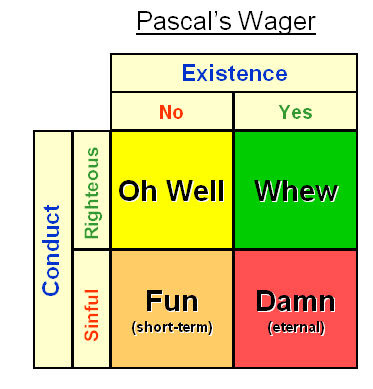
The assignment is based on the Pascal reading from the textbook. Like the other reading responses, you won't be graded on your opinion. You'll be graded on how well you DEFEND your opinion. This assignment is potentially worth the value of half a reading response (up to 25 points).

Also, just a reminder: the 4th reading response is a freebie. You don't have to write one, and everyone will get full credit for it.

You're welcome!
It Pays to Believe?

Friday, November 21, 2008

Bad Things to Good People

Here are some links on the problem of evil.

The first link is a collection of resources all about the problem of evil, including criticisms of several different responses to the problem. I mean, wow.

The NPR program Fresh Air has an audio interview with Bart Ehrman on the problem of suffering.

Next is a discussion of the "God works in mysterious ways" response: do we have enough evidence to believe that there is a reason for all the suffering in the world, but humans aren't smart enough to understand what that reason is?

Finally, does everything happen for a reason? This cartoon dinosaur has an interesting take on that question. (T-Rex also occasionally wonders why bad things happen to nice people.)

The Problem of EvilCat

Sunday, November 16, 2008

Reading Response #3

Reading Response #3 is due at the beginning of class on Thursday, November 20th for the Pemberton class, and Friday, November 21st for the Willingboro class. Here is the assignment:

Explain and evaluate the Design Argument for God's existence.
  • First, briefly explain whatever version of the Design Argument you prefer to explain: Paley's argument by analogy, the inductive version Hume criticizes, or the abductive version we discussed in class.
  • Then, tell me your opinion. Do you think it is a good argument or a bad argument? Why? Be sure to defend your opinion with reasons.
The response is based on the William Paley and David Hume readings from the textbook. Like the other reading responses, you won't be graded on your opinion. You'll be graded on how well you DEFEND your opinion.

Too Complex, Not Ordered Enough

Saturday, November 8, 2008

Like A Watch, Only More So

Here are some links on the design argument for God's existence. First is a radio interview on Hume's criticisms of the design arg. Second is an article on evolution versus intelligent design.

Third is the article about all the "design flaws" in nature. Fourth, here's an article on the recent research that might show the appendix serves a purpose, and so wouldn't count as a design flaw.

I also have a little music for you. Here's the source of the "more so" phrase:

John Gorka - I'm From New Jersey
"I'm from New Jersey | It's like Ohio | But even more so | Imagine that"


Finally, the National Public Radio show Fresh Air ran a pair of interviews with two scientists talking about whether God exists. The conversations touch on a lot of things we've been discussing in class.
Hey, where's the interview with an agnostic? The media are so biased toward those with opinions.

If you've read a good article on intelligent design, recommend it to us by emailing me or posting the link in the comments section of this post.

And We Thought You Were Useless, Mr. Appendix

Wednesday, November 5, 2008

Think [Tap-Dance] God

There's a philosophy comic strip that ran a whole series on the ontological argument that god exists. Here are links to the comics:


If you're still jonesing for the a priori, there's also this entry on ontological arguments in the Stanford Encyclopedia of Philosophy. Or maybe you like modal logic? If so, try Godel's version of the ontological argument.

Finally, here's what Guanilo said to Anselm after he presented Anselm his "Greatest Possible Island" criticism:

OH SNAP

Thursday, October 30, 2008

Midterm on Tuesday

This is just a reminder that the midterm is on Tuesday, November 4th for the Pemberton class, and Friday, November 7th for the Willingboro class.

Also, CONGRATS TO THE WORLD CHAMPIONS OF BASEBALL!

Tuesday, October 21, 2008

Easy on the Stubborn

So I left the Pemberton class today a little worried about stubbornness.

One of the goals of this class is to get us all to recognize what counts as good evidence and what counts as bad evidence for a claim. I think we're getting better at that. But it's not clear that we're caring about the difference once we figure it out.

We should care about good evidence. We should care about it because it's what gets us closer to the truth. When we judge an argument to be overall good, THE POWER OF LOGIC COMPELS US to believe the conclusion. If someone likes an arg, but still stubbornly disagree with its conclusion, she or he is just being irrational.

This means we should be open-minded. We should be willing to let new evidence change our current beliefs. We should be open to the possibility that we might be wrong.

Here are the first two paragraphs of a great article I just read:

Last week, I jokingly asked a health club acquaintance whether he would change his mind about his choice for president if presented with sufficient facts that contradicted his present beliefs. He responded with utter confidence. "Absolutely not," he said. "No new facts will change my mind because I know that these facts are correct."

I was floored. In his brief rebuttal, he blindly demonstrated overconfidence in his own ideas and the inability to consider how new facts might alter a presently cherished opinion. Worse, he seemed unaware of how irrational his response might appear to others. It's clear, I thought, that carefully constructed arguments and presentation of irrefutable evidence will not change this man's mind.

The full article is available here (you have to wait for an ad to play, then click 'Enter Salon' at the top right, to see the article).

I think that most of the time, stubbornness is unwarranted. Psychological research has repeatedly shown that most Americans overestimate their own abilities. This is one of the biggest hurdles to proper reasoning: the natural tendency to think that we're smarter--or more powerful, or prettier, or whatever--than we really are.

This may sound insulting, but one of the goals of this class is getting us to recognize that we're not as smart as we think we are. All of us. You. Me! That one. You again. Me again!

So in the upcoming weeks, at least, I hope you'll join me in my campaign to end I'M-SPECIAL-ism.
Anti-I'M-SPECIAL-ism: No, You're Not

Friday, October 17, 2008

Past Futures Are the New Past Pasts

Do you find yourself obsessed with Hume's question of what could justify inductive reasoning? Boy, do I have a link for you:

Stanford Encyclopedia of Philosophy: The Problem of Induction

If you're tired of that one, there's also a new problem of induction. Or, you could watch this video of Lewis Black describing his failure to reason inductively every year around Halloween:


In class, we talked about how attempts to justify induction beg the question. Here's a dinosaur comic on question-begging. (Click on the comic to enlarge it)

DOWN WITH DESCRIPTIVISTS IN THIS ONE PARTICULAR INSTANCE
And here's the video for Mims's logically delicious song "This is Why I'm Hot":


Finally, here's a stick figure comic about scientists' efforts to confirm that the future will be like the past.

Science: Confirming Induction For As Long As It's Been Unjustified

Friday, October 10, 2008

Innate Ideas? I've Had a Few

Here are a couple articles by Steven Pinker that offer some psychological insights on the innate ideas debate we've been discussing in class:


But hey, why read when you can watch a video? With that in mind, here's Pinker's appearance on The Colbert Report:


Pinker has a few books on this stuff, and a lot of other interesting articles, too. Not everyone agrees with Pinker, though. Here's an article about a South American tribe that might be a counterexample to the claim that there are innate aspects of language development.

The Interpreter

(The linguist researching the tribe explains his case more here. Steven Pinker and others respond to him here.)

One more link. Here's an advanced survey article on the rationalism/empiricism debate from my favorite free online philosophy encyclopedia:


Yes, there is more than one free online philosophy encyclopedia.

Wednesday, October 8, 2008

Reading Response #2

Reading Response #2 is due at the beginning of class on Tuesday, October 14th for the Pemberton class, and Friday, October 17th for the Willingboro class. Here is the assignment:

Explain and evaluate your thoughts about God.
  • First, explain what it is you believe about the existence of God. Do you believe there is a God? If so, what kind of God or Gods? Do you believe that there is no God? Do you not have a belief one way or the other?
  • Next, explain why you believe whatever it is you believe about God. What reasons do you have for believing what you believe? Figure out your argument in support of your belief (even if you're belief is "I don't know," explain why you don't know!).
  • Finally, evaluate your argument for what you believe. Do you think these are good reasons, or bad reasons? Why?
The response isn't based on any specific reading from the textbook. Instead, it's more of a chance for you to think about your own opinion before we discuss God stuff in class over the next several weeks. You won't be graded on your opinion. You'll be graded on how well you EXPLAIN and EVALUATE your reasons for your opinion.

God Likes Carrots

Tuesday, September 23, 2008

Link-Tested, Keanu-Approved

Here's a trio of links. The first one is a guide to reading philosophy that might help you if you're having trouble understanding the assigned readings.


The next two relate to knowledge and skepticism. The first is about the philosophical implications of the movie The Matrix. If Neo read it, he'd say "whoa."

The last link is an interesting take on skeptical scenarios (or what our textbook fancily calls universal belief falsifiers). Most of us think it's pretty unlikely that we're in a computer simulation like the Matrix. After all, these skeptical scenarios seem so weird. But Nick Bostrom provides some compelling reasons to think that these scenarios may be highly probable, after all.


(A more advanced version of Bostrom's argument is available here, and a dinosaur comic on this issue is available here.) By the way, if you have any links you think I or others in class might find interesting, let me know. And feel free to comment on any of these posts.

apparently this cat believes certainty is a requirement for knowledge

Thursday, September 18, 2008

Reading Response #1

Reading Response #1 is due at the beginning of class on Tuesday, September for 23rd for the Pemberton Class, and Friday, September 26th for the Willingboro class. In a 250- to 500-word essay response, answer the following question:

What does Descartes say he cannot be certain of? What does Descartes say he can be certain of? What are his arguments for these? Evaluate his arguments: do you agree with Descartes? Why or why not?
The response is based on the Descartes reading from pages 65-71 of the textbook.

Descartes: I'm in ur dreams, questioning ur certainties

Sunday, September 14, 2008

Understanding Args

Here are the answers to the handout on understanding arguments.

1. (P1) Fairdale has the best team.
(C) Fairdale will win the championship

2. (P1) The housing market is depressed.
(P2) Interest rates are low.
(C) It's a good time to buy a home.

3. (P1) China is guilty of extreme human rights abuses.
(P2) China refuses to implement democratic reforms.
(C) The U.S. should refuse to deal with the present Chinese government.

4. (P1) The results of the Persian Gulf War were obviously successful for the U.S. military.
(C) The U. S. military is both capable and competent.

5. (P1) Scientific discoveries are continually debunking religious myths.
(P2) Science provides the only hope for solving the many problems faced by humankind.
(C) Science provides a more accurate view of human life than does religion.

6. (P1) Freedom of speech and expressions are essential to a democratic form of government.
(P2) As soon as we allow some censorship, it won't be long before censorship will be used to silence the opinions critical of the government.
(P3) Once we allow some censorship, we will have no more freedom than the Germans did under Hitler.
(C) We must resist all effort to allow the government to censor entertainment.

7. (P1) I'm very good at my job.
(C) I deserve a raise.

8. (P1) Jesse is one year old.
(P2) Most one-year-olds can walk.
(C) Jesse can walk.

9 (P1) The revocation of the 55 mph speed limit has resulted in an increased number of auto fatalities.
(C) we must alleviate this problem with stricter speed limit enforcement.

10. (P1) The last person we hired from Bayview Tech turned out to be a bad employee.
(C) I'm not willing to hire anybody else from that school again.

11. (P1) Maebe didn't show up for work today.
(P2) Maebe has never missed work unless she was sick.
(C) Maebe is probably sick today.

11. (P1) The United States, as the most powerful nation in the world, has a moral obligation to give assistance to people who are subjected to inhumane treatment.
(P2) The ethnic Albanians were being persecuted in Kosovo.
(C) It was proper for the U.S. to become involved in the air campaign against Kosovo.

----------------
Hat tip: I took some of the examples (with some revisions) from Beth Rosdatter's website, and some (with some revisions) from Jon Young's website.

The LOLCat Dolls

Tuesday, September 9, 2008

Deductive Args

Here are the answers to the handout on deductive arguments that we went over in class.

1) All bats are mammals.
All mammals live on earth.
All bats live on earth.

Valid, Sound

2) All students in here are mammals.
All humans are mammals.
All students in here are humans.

Invalid (what if a dog were a student in our class?),
Unsound (because it's invalid)

3) (from Stephen Colbert)
Bush is either a great prez or the greatest prez.
Bush isn’t a great prez.
Bush is the greatest prez.

Valid, Unsound (questionable premises)

4) All BCC students are humans.
Most humans are shorter than 7 feet tall.
Most BCC students are shorter than 7 feet tall.

Invalid (there could be a lot of tall BCC students even if most humans aren't tall), Unsound (because it's invalid)
5) Some people are funny.
Sean is a person.
Sean is funny.

Invalid (only some are funny, so I don't have to be funny), Unsound (because it's invalid)
6) If Sean sings, then students cringe.
Sean is singing right now.
Students are cringing right now.

Valid, Unsound (false second premise: I'm not singing right now)
7) All email forwards are annoying.
Some email forwards are false.
Some annoying things are false.

Valid, Unsound (questionable first premise)
8) If Sean sings, then students cringe.
Sean isn't singing right now.
Students aren't cringing right now.

Invalid (students could cringe for a different reason), Unsound (it's invalid)
9) All bats are mammals.
All bats have wings.
All mammals have wings.

Invalid (bad structure), Unsound (because it's invalid)
10) If Sean sings, then students cringe.
Students aren't cringing right now.
Sean isn't singing right now.
Valid, Unound (first premise is questionable)
11) All dads have beards.
All bearded people are mean.
All dads are mean.
Valid, Unsound (premise 1 is false and premise 2 is questionable)
12) If Sean sings, then students cringe.
Students are cringing right now.
Sean is singing right now.

Invalid (I don't have to sing for students to cringe), Unsound (it's invalid, and false second premise)

13) Mexico borders oceans on the east and west.
USA borders oceans on the east and west.
Guatemala borders oceans on the east and west.
Australia borders oceans on the east and west.
Most countries border oceans on the east and west.
Invalid (the premises don't guarantee the conclusion), Unsound (it's invalid)